The Electric Car Market Has Reached a New Level
Electric cars in 2026 are no longer defined by compromise. The conversation has moved beyond whether EVs can work in daily life and toward which ones deliver the best balance of range, price, charging speed, comfort, software, and straight-line performance. That is a major shift. A few years ago, many buyers had to choose one strength and accept several weaknesses. Now, the strongest electric cars are far more complete products. That makes ranking the best electric cars of 2026 more interesting than ever. Some models lead on pure range, others dominate on value, and a few combine serious acceleration with strong real-world usability. Lucid continues to set the pace for range in the luxury space, Tesla remains highly competitive on efficiency and pricing, Chevrolet is pushing affordability lower, and brands like Hyundai, Ford, BMW, Kia, and Porsche have each carved out distinct strengths in design, charging, practicality, or performance. This ranking focuses on the models that stand out most clearly for shoppers in 2026. It weighs three big factors above all else: how far the car can go on a charge, what it costs to get into one, and how well it performs both on paper and in everyday driving. The result is not just a list of fast EVs or cheap EVs. It is a practical guide to the most compelling electric cars on sale right now.
A: It depends on priorities, but the Lucid Air Grand Touring stands out for luxury and range, while the Tesla Model 3 remains a top all-around mainstream pick.
A: The Lucid Air Grand Touring leads here with a headline EPA-estimated range above 500 miles.
A: The Chevrolet Equinox EV is one of the strongest value-focused EVs thanks to its price and useful range.
A: The Kia EV9 is one of the best options for larger families because it offers three-row practicality.
A: The Porsche Taycan and Ford Mustang Mach-E GT are standout choices for buyers who prioritize speed and driving excitement.
A: In many cases, yes, because they have fewer routine service needs like oil changes and engine-related repairs.
A: Not always; charging speed, price, comfort, and daily practicality can matter just as much.
A: It is not strictly required, but it makes EV ownership much easier for most drivers.
A: They can be if you value stronger materials, quieter cabins, better tech integration, and higher performance.
A: Start with budget, expected daily mileage, charging access, and whether you want a sedan, crossover, or larger SUV.
1. Lucid Air Grand Touring
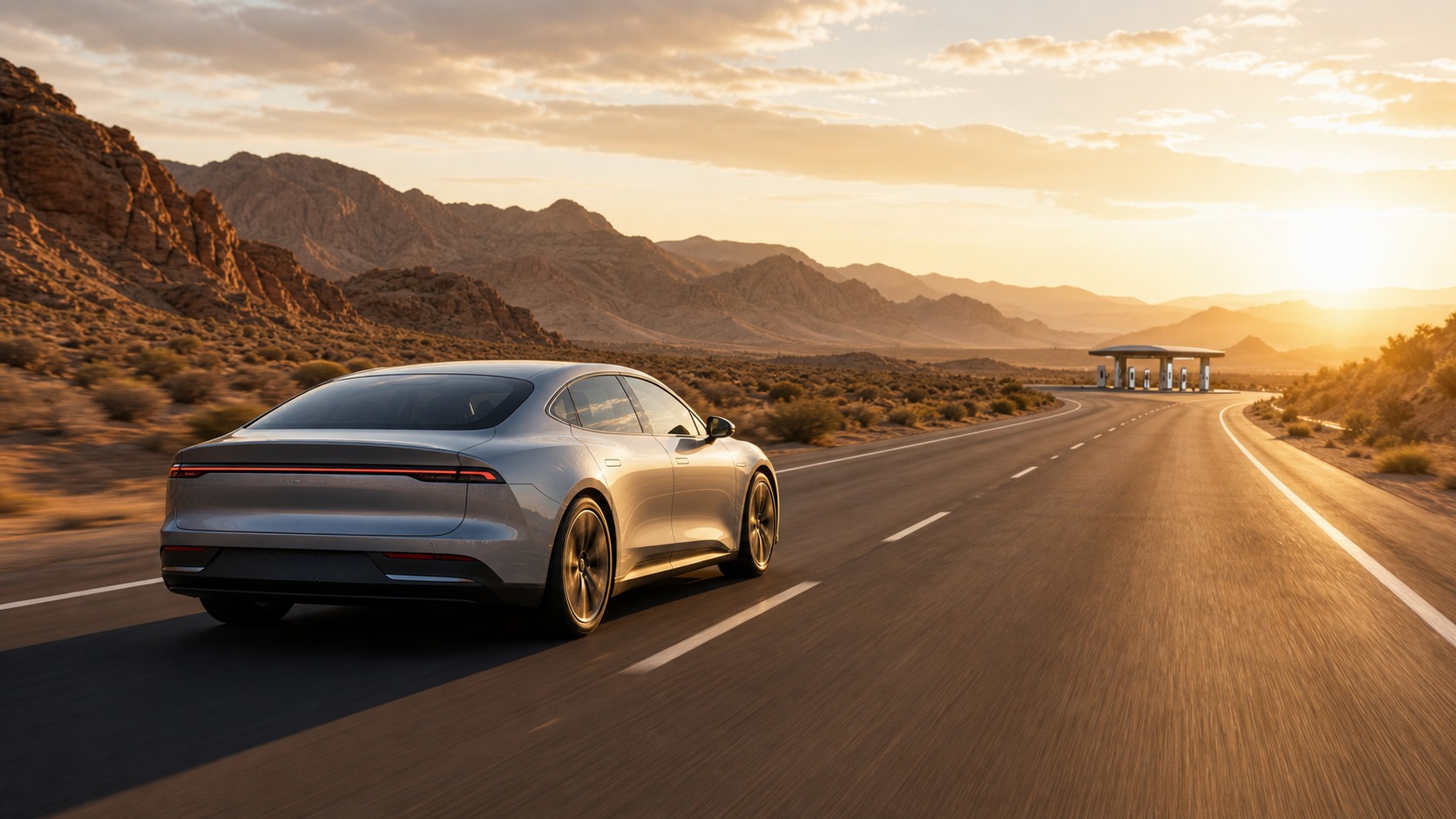
If the goal is to identify the EV that most dramatically stretches what an electric car can do, the Lucid Air Grand Touring deserves the top spot. Lucid lists the 2026 Air Grand Touring at up to 512 miles of EPA-estimated range, with 819 horsepower and a 0–60 time of 3.0 seconds. It starts from $114,900, which clearly places it in premium territory, but that combination of distance, speed, and refinement is still unusual even in the luxury class.
What makes the Air Grand Touring so impressive is that it does not win on just one number. Plenty of performance EVs are quick, and a few luxury EVs feel upscale, but very few pair a 500-plus-mile headline with true grand-touring ability. This is the model that best represents the outer edge of current EV capability. For buyers who want the longest-range serious luxury sedan on the market, it sets the benchmark.
2. Tesla Model 3
The Tesla Model 3 remains one of the smartest all-around electric car choices because it combines strong pricing with strong efficiency and very broad appeal. Tesla lists the Model 3 Rear-Wheel Drive at $38,630 to start, with the Premium Rear-Wheel Drive at $44,130, Premium All-Wheel Drive at $49,130, and Performance All-Wheel Drive at $56,630. EPA data for the 2025 Model 3 lineup on FuelEconomy.gov continues to show class-leading efficiency, and Tesla’s current 2026 pricing keeps it squarely in the middle of the mainstream EV conversation. The reason the Model 3 ranks so high is not because it is the cheapest or the fastest. It ranks highly because it does nearly everything well enough to satisfy a wide range of buyers. It is efficient, quick, widely recognized, and still one of the easiest EVs to recommend for commuters, tech-focused buyers, and first-time electric car owners. In a category where some models feel specialized, the Model 3 still feels broadly useful.
3. Chevrolet Equinox EV
For value, the Chevrolet Equinox EV is one of the most important electric cars in the market right now. Chevrolet lists the 2026 Equinox EV starting at $34,995, and quotes up to 319 miles of EPA-estimated range with front-wheel drive. That matters because affordability in the EV market often comes with range compromises, but the Equinox EV enters at a price point that feels accessible while still offering numbers that fit normal daily life and even occasional road-trip duty.
This is the EV that makes the strongest case for mass-market adoption. It is not the flashiest model on this list, and it is not meant to be. Instead, it targets the real center of the car-buying market: people who want space, reasonable pricing, familiar usability, and enough range to stop thinking about the battery every day. For families and budget-minded buyers, it is one of the most meaningful EV launches available in 2026.
4. Hyundai IONIQ 5
The Hyundai IONIQ 5 continues to stand out because it feels distinct without becoming impractical. Hyundai lists the 2025 IONIQ 5 starting MSRP at $42,600, while FuelEconomy.gov shows up to 303 miles of EPA range for the long-range rear-wheel-drive version. Hyundai also positions the model as a fast-charging electric SUV, which has been one of its strongest real-world advantages. What keeps the IONIQ 5 near the top is balance. It is stylish, roomy, easy to live with, and competitive in range without needing luxury-car pricing. It also occupies a useful middle ground between compact efficiency and crossover practicality. For buyers who want something more design-forward than a traditional entry EV, but not as expensive as a high-end luxury model, the IONIQ 5 remains one of the best-rounded picks in the class.
5. Ford Mustang Mach-E
The Ford Mustang Mach-E remains one of the strongest mainstream performance-oriented EVs because it offers a broad lineup rather than a single personality. Ford lists the 2026 Mustang Mach-E starting at $37,795, with up to 320 miles of EPA-estimated range. Ford also states that the quickest GT Performance Upgrade version can hit 0–60 mph in 3.3 seconds, while the GT model produces up to 480 horsepower.
That range of personalities is exactly why it ranks so well. In one lineup, Ford covers buyers who want an attainable daily EV, those who want a premium-looking crossover, and those who want something seriously quick. The Mach-E is not the cheapest, nor is it the longest-range model here, but it offers one of the most flexible mixes of price, style, and performance in the segment.
6. BMW i4
The BMW i4 remains one of the best choices for buyers who still want their EV to feel very much like a traditional premium sport sedan. BMW says the 2026 i4 eDrive40 offers between 307 and 333 miles of range, while BMW’s current offer page shows an MSRP of $60,700 for the 2026 i4 eDrive40 including destination. BMW also highlights fast charging and a more driver-focused character than many EV crossovers. The i4 earns its place because it is one of the more convincing “bridge” EVs for shoppers moving out of luxury gas sedans. It looks familiar, drives with BMW’s usual focus on composure and pace, and still offers range that is entirely competitive. It does not rewrite the rules like Lucid, but it is easy to picture living with every day, and that matters.
7. Kia EV9
The Kia EV9 is one of the most appealing electric family vehicles because it brings genuine three-row SUV practicality into the EV space without losing range credibility. Kia’s 2026 EV9 page emphasizes long-distance range and fast charging, while Kia’s EV landing page lists the 2026 EV9 at up to 305 miles EPA-estimated range. Kia’s specs page shows pricing from $54,900 for the Light RWD trim, with higher trims reaching into the $60,000 and $70,000 range.
There are faster EVs and cheaper EVs, but very few are as useful for larger households. The EV9 is important because it proves an electric SUV can be spacious, visually bold, and genuinely road-trip capable. For families who need more than two rows, it is one of the clearest answers on the market.
8. Porsche Taycan
The Porsche Taycan remains one of the definitive electric performance cars because it prioritizes driving feel rather than just headline speed. Porsche’s U.S. Taycan lineup starts at $105,800, and current Porsche Finder inventory shows a 2026 Taycan GTS with an EPA-estimated range of 293 miles. FuelEconomy.gov listings for the Taycan family continue to show a wide spread of trims and performance variants, reinforcing its role as a deep, enthusiast-focused lineup rather than a single simplified EV offering. The Taycan is not here because it is the rational value pick. It is here because no ranking of the best EVs would feel complete without a car that makes performance part of the emotional equation. Porsche has kept the Taycan relevant by combining sports-sedan credibility with premium build quality and a charging-and-driving package that still feels serious in 2026.
What These Rankings Really Mean
The most interesting part of the 2026 EV market is that “best” no longer means one thing. The Lucid Air Grand Touring is the best range-forward luxury statement. The Tesla Model 3 is arguably the best mainstream all-rounder. The Chevrolet Equinox EV may be the best value breakthrough. The Hyundai IONIQ 5 feels like one of the most complete design-and-practicality packages. The Ford Mustang Mach-E offers one of the broadest personality ranges. The BMW i4 gives premium sedan buyers an easier transition. The Kia EV9 is the family-hauler standout. The Porsche Taycan remains the enthusiast’s EV.
That also means shoppers should be cautious about relying on one metric alone. Range is easy to compare, but it does not tell the full story. A car with slightly less range but better fast-charging behavior, better interior packaging, or a lower starting price may be the better purchase. The same is true for performance. Quick acceleration is exciting, but for many buyers, software stability, seat comfort, charging convenience, and day-to-day usability are what determine long-term satisfaction.
How to Choose the Right EV in 2026
For budget-minded shoppers, the smartest place to start is with value-per-mile and overall usability. That pushes cars like the Chevrolet Equinox EV and Tesla Model 3 toward the front of the conversation. Buyers who prioritize longer trips and maximum range will naturally gravitate toward Lucid’s Air lineup, while those who want crossover practicality without giving up modern design should keep the Hyundai IONIQ 5 and Ford Mustang Mach-E high on the list. If your household needs three rows, the Kia EV9 is the standout. If your current garage contains a sport sedan and you are reluctant to surrender that feel, the BMW i4 and Porsche Taycan are stronger fits. In other words, the best EV is no longer simply the one with the biggest battery. It is the one whose character lines up with the way you actually drive.
Final Verdict
The best electric cars of 2026 show how quickly the market has matured. Buyers now have credible choices at several price points, from relatively affordable crossovers to luxury sedans with extraordinary range. No single model wins every category, but the strongest EVs now feel far more complete than early-generation electric cars ever did.
If the ranking is based on overall impact, the Lucid Air Grand Touring takes the crown for what it represents in range and luxury. For everyday mainstream buyers, though, the Tesla Model 3, Chevrolet Equinox EV, Hyundai IONIQ 5, and Ford Mustang Mach-E may prove more realistic and more relevant. That is the real story of 2026: electric cars are no longer just the future. They have become a broad, competitive present.