The Hidden System Behind Every Great Electric Vehicle
Electric vehicles may look smooth, quiet, and simple from the outside, but beneath the floor sits one of the most carefully managed systems in modern transportation: the battery pack. This pack does far more than store electricity. It powers acceleration, influences driving range, determines fast-charging ability, and plays a major role in long-term vehicle value. To do all of that reliably, it must stay within a carefully controlled temperature range. That is where EV battery cooling systems become essential. These systems manage heat before it becomes a problem, move warmth away from battery cells during demanding conditions, and help bring the pack to the right temperature when the weather turns cold. Battery cooling is not just an engineering detail tucked away under the vehicle. It is one of the main reasons today’s electric cars can charge quickly, drive long distances, deliver strong performance, and remain dependable over years of use.
A: Cooling helps control heat during driving and charging, protecting range, safety, performance, and battery life.
A: Liquid cooling usually manages heat more effectively, especially for long-range EVs, fast charging, and performance driving.
A: Yes. A well-managed battery can often accept higher charging power for longer before slowing down.
A: It is when the EV warms or cools the battery before fast charging or driving to improve performance.
A: Repeated high heat can speed up battery aging, which is why thermal management is so important.
A: Yes. Cold batteries may charge slower and deliver less power until they reach a better temperature.
A: Yes, but smart systems try to protect the battery while using as little energy as possible.
A: Absolutely. Battery temperature history and cooling design can affect long-term battery health.
A: Cold batteries accept energy more slowly, so the vehicle may need to warm the pack first.
A: It helps the vehicle stay safe, efficient, fast-charging capable, and reliable over time.
Why EV Batteries Need Temperature Control
A battery pack is made up of many individual cells working together. When the driver accelerates, charges, climbs hills, tows, or drives in extreme weather, those cells generate heat. Some heat is normal, but too much heat can reduce efficiency, slow charging, accelerate battery aging, and in severe cases create safety concerns. The challenge is not simply keeping the battery cold. The goal is keeping it in the right thermal zone.
Batteries are sensitive because chemical reactions happen inside every cell. When temperatures are too low, those reactions slow down, reducing power and charging performance. When temperatures are too high, the reactions can become harder to control and may gradually damage the materials inside the cell. A well-designed EV battery cooling system keeps the pack balanced so the vehicle feels consistent whether it is sitting in summer traffic, using a fast charger, or cruising on a cold highway morning.
The Basics of Heat Inside an EV Battery Pack
Heat inside an EV battery comes from electrical resistance, charging activity, power demands, and environmental conditions. When electricity moves through the battery, motor, inverter, and high-voltage wiring, some energy is lost as heat. The harder the system works, the more heat it can create. This is why aggressive acceleration, repeated high-speed driving, steep grades, and DC fast charging all place extra thermal demand on the battery. Heat also does not always spread evenly. Some cells may become warmer than others depending on pack design, cooling channel layout, current flow, and where the vehicle is being used. Uneven temperature is a serious design challenge because one hot area can age faster than the rest of the pack. Battery cooling systems are built to reduce these hot spots and keep thousands of cells working together as one controlled, stable energy system.
Air Cooling vs Liquid Cooling
Early and lower-cost electric vehicles sometimes used air cooling. In an air-cooled battery system, fans move air around or through parts of the battery pack to help remove heat. Air cooling can be simpler, lighter, and less expensive, but air does not carry heat away as efficiently as liquid. For smaller packs or less demanding vehicles, it may be enough. For high-performance EVs, long-range vehicles, and fast-charging platforms, air cooling can become limiting.
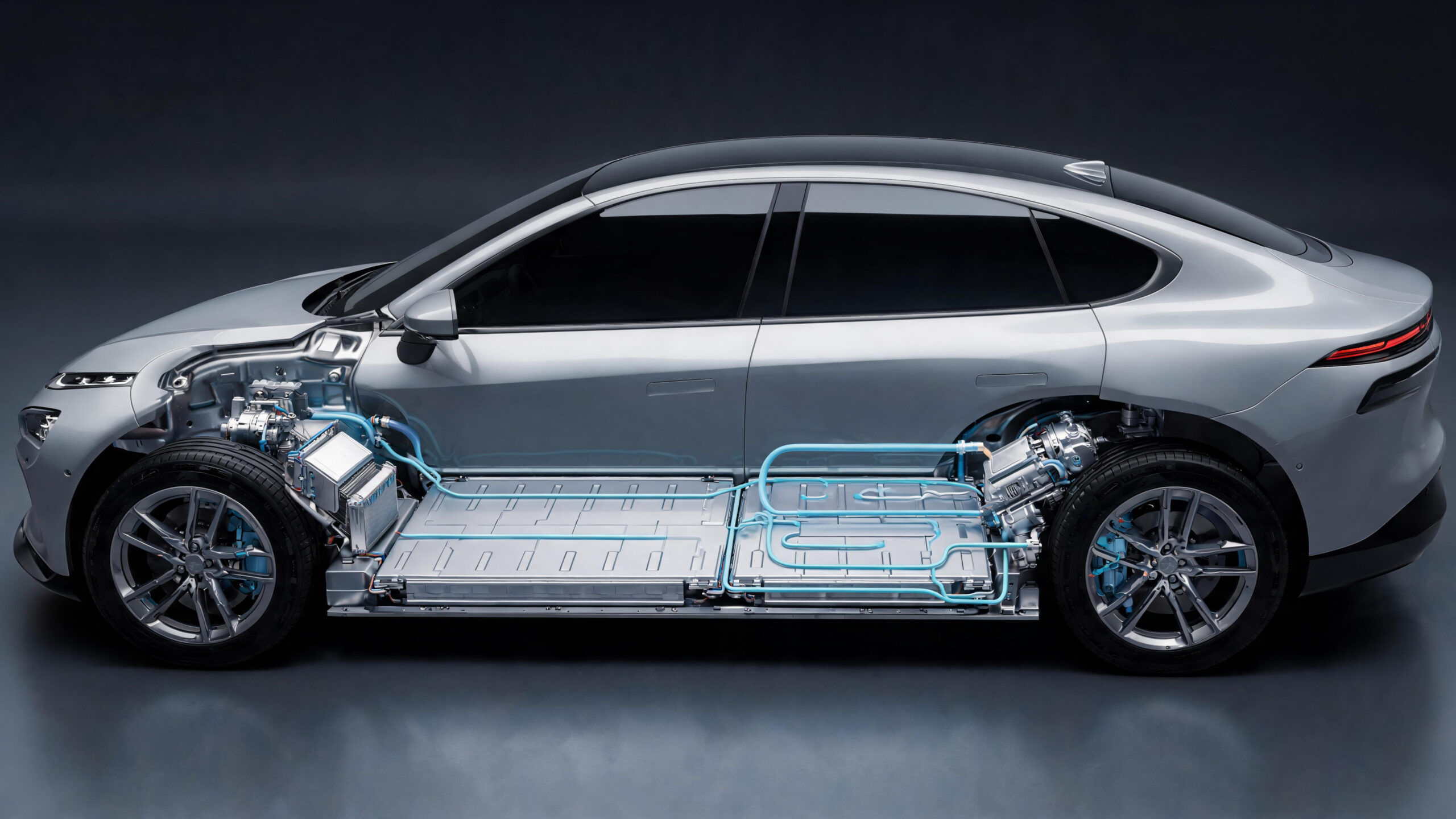
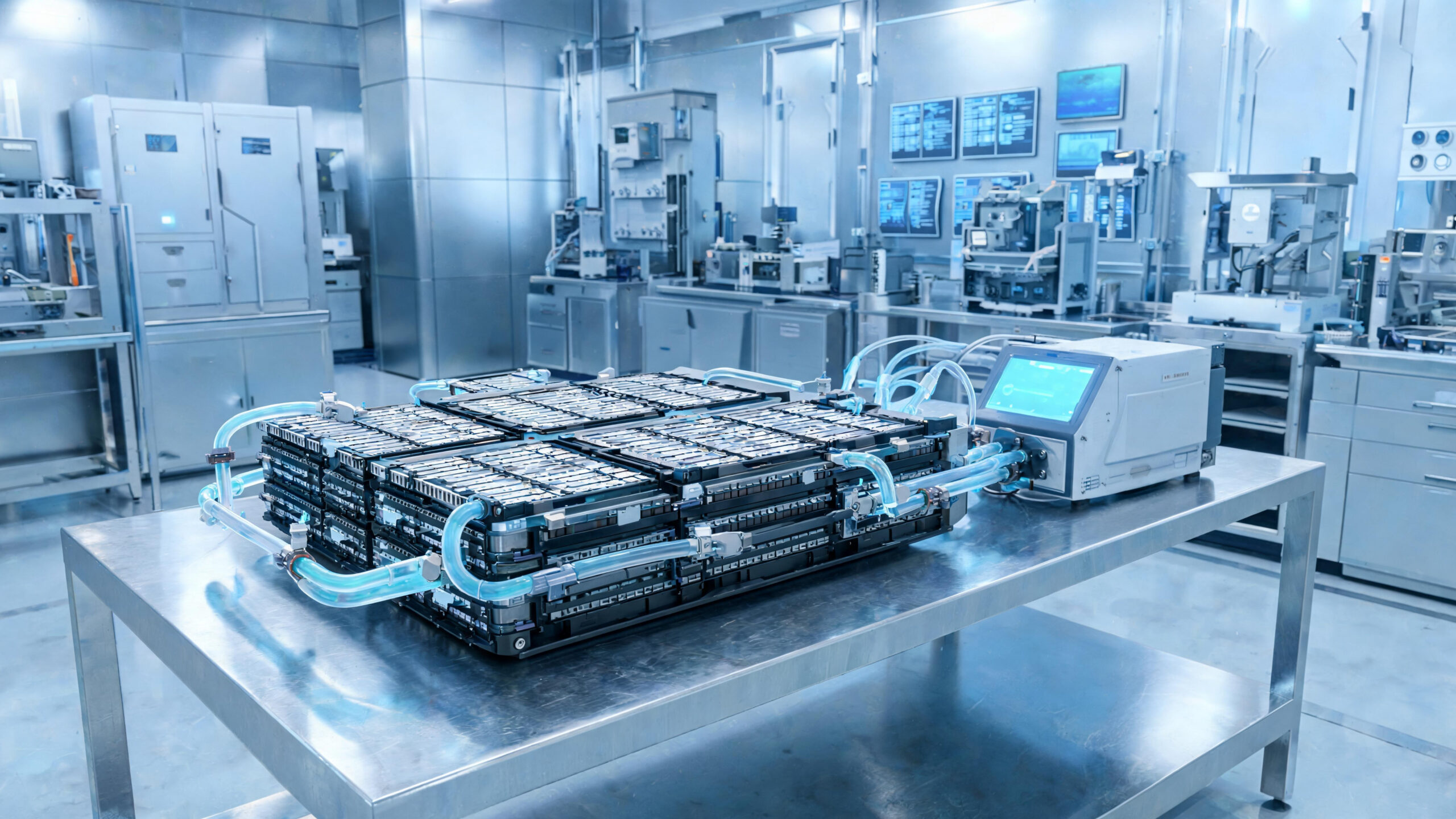
Liquid cooling is now common in many modern electric vehicles because liquid can absorb and move heat more effectively. In a liquid-cooled system, coolant circulates through channels, plates, or tubes near the battery cells. The coolant pulls heat away from the pack and moves it toward other thermal components, such as a radiator, chiller, or heat exchanger. This allows the vehicle to maintain tighter temperature control during demanding use, especially during high-speed charging or repeated performance driving.
How Liquid-Cooled EV Battery Systems Work
A liquid-cooled EV battery system usually begins with coolant flowing through a closed loop. This coolant passes near the battery cells through cooling plates, cold plates, channels, or thermal pathways built into the battery pack. As the battery creates heat, that heat transfers through surrounding materials and into the coolant. The warmed coolant then moves away from the pack so the heat can be released or redirected. The system is carefully controlled by pumps, valves, sensors, and software. Temperature sensors monitor conditions throughout the battery pack. The vehicle’s control system decides when to move coolant faster, when to route heat toward the radiator, when to use a chiller connected to the air-conditioning system, and when to warm the pack instead of cool it. The driver may never notice this process, but it is constantly working in the background to protect performance and efficiency.
Cooling Plates and Thermal Pathways
Cooling plates are among the most important parts of many EV battery cooling designs. These plates sit close to the battery cells or modules and create a controlled path for heat to leave the battery. They are often made from materials that conduct heat well, such as aluminum, and may contain internal channels where coolant flows. Their job is to pull heat away evenly without adding unnecessary weight or complexity.
Thermal interface materials also play a major role. These materials help fill tiny gaps between the battery cells, modules, and cooling surfaces. Without good contact, heat transfer becomes less efficient. Engineers must balance many details at once, including pressure, vibration, durability, electrical insulation, weight, serviceability, and cost. A cooling plate may look simple, but it is part of a highly tuned thermal design.
The Role of Coolant Loops
An EV may have one thermal loop or several interconnected loops. A simple system may use one coolant loop for the battery and another for the motor and power electronics. More advanced vehicles may integrate battery cooling, cabin heating, motor cooling, inverter cooling, heat pump operation, and fast-charging preparation into one coordinated thermal network. This lets the vehicle move heat where it is useful instead of wasting it. For example, heat generated by the motor or electronics might be used to help warm the battery in cold weather. During hot conditions, the system may send heat toward a radiator or use the refrigerant system to chill the coolant before it returns to the pack. The best systems are not just cooling systems. They are heat management systems designed to move thermal energy intelligently throughout the vehicle.
Why Fast Charging Creates So Much Heat
DC fast charging pushes a large amount of electrical power into the battery in a short period of time. That speed is convenient for drivers, but it creates major thermal stress. As charging power rises, the battery must accept energy quickly without overheating, creating uneven temperatures, or damaging the cells. If the pack gets too hot or too cold, the vehicle may automatically reduce charging speed to protect the battery.
This is why battery cooling is directly tied to fast-charging performance. An EV with an advanced cooling system can often sustain higher charging speeds for longer because it can remove heat effectively. A weaker cooling system may start strong but reduce charging speed sooner as temperatures rise. For drivers, this can mean the difference between a quick road-trip stop and a much longer wait.
Battery Preconditioning Explained
Battery preconditioning is one of the smartest features connected to EV thermal management. When the vehicle knows it is heading to a fast charger, it can begin warming or cooling the battery before arrival. This helps the pack reach an ideal charging temperature, allowing it to accept higher power more safely and efficiently. In cold weather, preconditioning can be especially important because a cold battery may charge slowly until it warms up. Preconditioning also helps reduce thermal shock. Instead of suddenly forcing the battery to handle fast charging while outside its preferred temperature range, the vehicle gradually prepares the pack. Some EVs activate this automatically when a fast charger is entered into the navigation system, while others allow the driver to manually start the process. Either way, it shows how battery cooling and heating are now part of the everyday EV driving experience.
How Cooling Protects Battery Life
Battery life is one of the biggest concerns for EV shoppers, and temperature control is central to long-term durability. Heat speeds up many forms of battery degradation. Repeated exposure to high temperatures can reduce the battery’s ability to hold energy over time. Even if the battery does not fail, it may gradually lose usable capacity, reducing range and resale confidence.
A strong battery cooling system helps slow this aging process by reducing extreme temperature exposure. It also helps keep cell temperatures balanced across the pack, which matters because uneven aging can reduce overall performance. Since the battery pack is one of the most expensive parts of an EV, thermal management is not just about comfort or speed. It is also about protecting one of the vehicle’s most valuable assets.
Cooling and EV Range
Thermal management affects range in several ways. When the battery is operating within its ideal temperature zone, it can deliver energy more efficiently. When it is too cold, the vehicle may use extra energy to warm the pack. When it is too hot, the cooling system may consume energy to protect the battery. In both cases, the thermal system helps protect the pack, but it can also influence how many miles the vehicle can travel on a charge. The best EVs balance this carefully. They keep the battery protected without wasting unnecessary energy. Heat pumps, smart coolant routing, predictive software, and efficient pumps all help reduce the energy cost of thermal control. This is one reason two EVs with similar battery sizes can behave differently in real-world driving. Battery chemistry matters, but thermal management can make a major difference in how usable that energy feels.
Hot Weather and Battery Cooling
In hot climates, an EV battery may already be warm before the vehicle even starts moving. Add highway driving, fast charging, heavy traffic, or towing, and the cooling system has to work harder. Without effective cooling, the battery could reduce power output or charging speed to protect itself. Drivers might notice slower charging, reduced performance, or increased energy use from cooling demands.
Modern EVs are designed to handle hot environments, but thermal strategy still matters. Parking in shade, avoiding unnecessary fast charging in extreme heat, and allowing the vehicle’s cooling system to manage the pack can all help. The engineering challenge is especially difficult because the battery pack is usually enclosed for safety and protection. Engineers must remove heat from a sealed, durable structure while keeping the system efficient and reliable.
Cold Weather and Battery Heating
Battery thermal management is not only about cooling. In cold weather, EV batteries often need heating. A cold battery may deliver less power, accept charge more slowly, and reduce regenerative braking performance. The vehicle may use energy to warm the pack before driving or charging, which can temporarily reduce range. This is one reason EV range often drops during winter. Advanced thermal systems reduce this impact by warming the battery efficiently and coordinating that heating with cabin comfort. Heat pumps can help by moving heat rather than relying only on resistive heaters. Some systems recover waste heat from motors or power electronics. The goal is to keep the battery warm enough for good performance while using as little energy as possible.
Thermal Runaway and Safety
Thermal runaway is a serious battery safety issue that occurs when a cell overheats and triggers a chain reaction that can spread heat to nearby cells. This is rare, but it is one of the reasons EV battery packs are engineered with multiple layers of protection. Cooling systems, temperature sensors, battery management software, physical barriers, venting paths, and cell spacing all work together to reduce risk.
Battery cooling is not the only safety feature, but it is an important one. By detecting and controlling abnormal heat early, the vehicle can reduce power, limit charging, activate cooling, or warn the driver. Engineers also design packs to contain or slow heat propagation if a cell problem occurs. Good thermal management is part of a larger safety strategy that makes modern EVs far more sophisticated than a simple box of batteries.
Power Electronics and Motor Cooling
The battery is not the only part of an EV that needs thermal control. Motors, inverters, onboard chargers, and DC-DC converters also create heat. The inverter is especially important because it converts battery power into the form needed by the motor. During hard acceleration or high-speed driving, this component can heat up quickly. If it becomes too hot, performance may be limited. Many EV thermal systems coordinate battery cooling with power electronics and motor cooling. These components may use separate coolant loops or shared thermal circuits depending on vehicle design. Managing all of them together allows the car to maintain consistent performance. A great EV does not just need a strong battery. It needs an entire thermal ecosystem that supports every high-voltage component.
Software: The Brain of EV Thermal Management
Hardware moves the heat, but software decides what happens and when. The battery management system tracks cell temperatures, voltage, current, state of charge, driving demand, charging conditions, and environmental data. It uses this information to control pumps, fans, valves, heaters, chillers, and charging limits. This software is constantly making small decisions that affect range, battery health, and performance.
As EVs become more advanced, thermal software is becoming more predictive. A vehicle may use navigation data, charger location, weather conditions, driving style, and battery history to prepare the pack before it is stressed. Over-the-air updates can also improve thermal strategies after the vehicle has already been sold. This means EV cooling is no longer just mechanical engineering. It is also data-driven energy management.
Why Performance EVs Need Advanced Cooling
High-performance electric vehicles place extreme demands on their battery packs. Rapid acceleration pulls large amounts of power from the cells. Track driving creates repeated heat cycles. High-speed driving can stress the motor, inverter, and battery at the same time. Without strong cooling, the vehicle may reduce output after only a short period of intense use. Advanced cooling allows performance EVs to deliver repeatable power. It helps prevent the battery from overheating during launches, corner exits, and sustained high-speed operation. This is why thermal management is a major factor in electric sports cars, super sedans, and high-output electric trucks. Peak horsepower may grab attention, but cooling determines how long that performance can last.
Why Everyday Drivers Should Care
Most EV owners will never see their battery cooling system, but they benefit from it every day. It helps the vehicle charge faster, drive farther, last longer, and respond more consistently. It also protects the battery during heat waves, winter mornings, road trips, mountain climbs, and daily commuting. The smoother the experience feels, the more likely it is that thermal management is doing its job well.
Drivers shopping for an EV should pay attention to battery cooling, especially if they plan to fast charge often, drive in extreme climates, tow, buy used, or keep the vehicle for many years. Liquid-cooled battery packs are generally preferred for modern long-range EVs because they support stronger thermal control. While battery size and range ratings matter, the cooling system helps determine how well those numbers hold up in real life.
The Future of EV Battery Cooling
EV battery cooling will continue to evolve as automakers chase faster charging, longer range, lighter packs, and lower costs. New cooling plate designs, better thermal interface materials, immersion cooling concepts, smarter heat pumps, and more efficient coolant routing are all part of the future. As battery chemistries change, thermal systems will adapt with them. Solid-state batteries, high-voltage architectures, and ultra-fast charging networks may all increase the importance of thermal management. The EVs of the future will not simply have bigger batteries. They will have smarter systems that control heat with greater precision. In many ways, the next leap in electric vehicle performance may come not just from storing more energy, but from managing heat better.
Final Thoughts: Cooling Is the Quiet Hero of EV Engineering
EV battery cooling systems are easy to overlook because they work silently beneath the vehicle. Yet they influence nearly every part of the electric driving experience. They protect range, support fast charging, improve safety, extend battery life, and help electric vehicles perform in conditions that would otherwise strain the pack.
As EV technology advances, thermal management will become even more important. The vehicles that charge fastest, last longest, and perform most consistently will depend on intelligent cooling and heating systems working behind the scenes. Battery cooling may not be the flashiest part of an electric vehicle, but it is one of the most important. It is the quiet engineering hero that helps turn stored energy into confident, reliable motion.